Gaza’s Christians mourn mother and daughter killed in Israeli attack
 Oct 4, 2026 · byAl Jazeera
28 articles

Maysa Abu Daoud and her daughter Mary al-Najjar among five Palestinians killed in Gaza City attack.
Oct 4, 2026 · byAl Jazeera
An Israeli airstrike killed at least five Palestinians, including four women, in an apartment building in Gaza City early on Saturday, health and civil defence service officials said.

An Israeli air attack on a residential apartment in Gaza City has killed at least five Palestinians.
Oct 3, 2026 · byAl Jazeera
No warning was given before the deadly Israeli attack hit Remal, one of Gaza City's most crowded neighbourhoods.
Oct 3, 2026 · byAl Jazeera
The remains of 105 people were buried in the Sheikh Radwan cemetery, northwest of Gaza City.
Oct 1, 2026 · byAl Jazeera![oPt: UNRWA Situation Report #235 on the Humanitarian Crisis in the Gaza Strip and the occupied West Bank, including East Jerusalem [EN/AR]](https://reliefweb.int/sites/default/files/styles/thumbnail/public/previews/6c/f6/6cf669ba-4a3a-4719-b10f-4f3968be0d52.png)
Country: occupied Palestinian territory Source: UN Relief and Works Agency for Palestine Refugees in the Near East Please refer to the attached files. Highlights The Gaza Strip UNRWA started the 2026/2027 school year on 19 September across the Gaza Strip through a combination of in-person and distance learning. A launch event was held in Nuseirat Camp at an UNRWA school that has fully returned to education use, after having been used previously as an emergency shelter. During the first week of the school year, nearly 97,000 students attended UNRWA learning spaces across the Gaza Strip. Students also returned to in-person learning at both campuses of the UNRWA Rehabilitation Centre for the Visually Impaired (RCVI), with classes resuming in Deir El Balah on 19 September and in Gaza City on 20 September. UNRWA opened two additional carpentry workshops, bringing the total to three facilities operating in Khan Younis, Deir El Balah and Gaza City. Together, the workshops can produce approximately 450 school desks and chairs per week to support the expansion of learning spaces. Multiple war-damaged residential buildings collapsed in the Gaza Strip during the reporting period, highlighting the risks faced by families sheltering in unsafe structures. UN Humanitarian Coordinator Ramiz Alakbarov warned that people live in “hundreds of damaged structures assessed as unsafe, for lack of better options”. These include some families sheltering in non-operational UNRWA installations, which are no longer managed by UNRWA, for safety reasons. With winter approaching, risks are expected to increase as rainfall further weakens already compromised structures. UNRWA remains engaged in inter-agency efforts to address the issue and encourage families to relocate to safer shelter options where available. Over the reporting period, Israeli authorities issued multiple evacuation orders and shelter-in-place alerts affecting UNRWA installations across the Gaza Strip. Separately, hostilities in the vicinity of UNRWA facilities resulted in injuries to six displaced persons sheltering at UNRWA schools, including four children. One cash-for-work beneficiary supporting UNRWA operations was killed and one UNRWA staff member seriously injured in separate incidents linked to strikes by Israeli forces in their vicinity. Key points The Gaza Strip Fatalities and injuries Between 7 October 2023 and 20 September 2026, according to the Ministry of Health, as reported by the Health Cluster , 73,914 Palestinians were killed in the Gaza Strip and another 174,952 were injured. This includes 1,394 fatalities and 4,991 injuries between the announcement of a ceasefire agreement on 10 October 2025 and 20 September 2026. UNRWA has recorded 394 colleagues killed in the Gaza Strip since the start of the war (311 UNRWA personnel and 83 persons who were supporting UNRWA [2] , as of 22 September. Health crisis The worsening fuel and engine oil shortage is increasingly disrupting health services across the Gaza Strip. The UN warned that reduced fuel support to hospitals, driven by funding shortfalls and high procurement costs, could affect most hospitals and lead to cuts in primary and secondary healthcare services. Over the reporting period, several UNRWA health centres also experienced temporary disruptions due to generator overload, highlighting the growing operational impact of the shortage of fuel, lubricant oil and spare parts on the delivery of healthcare. Water, sanitation and hygiene (WASH) needs According to the WASH Cluster’s Light Touch Monitoring Survey , completed in early July 2026, 90 per cent of the population are experiencing frequent, unpredictable disruptions in access to safe, clean, and reliable water for daily drinking, cooking, and hygiene – an increase from 84 per cent the previous month. Shelter needs According to the Shelter Cluster’s classification , based on surveys conducted between 14 and 28 June 2026, an estimated 1.98 million people, representing 94 per cent of the population of the Gaza Strip, require shelter and non-food item assistance (NFI). The assessment also suggests that 58 per cent of the population is facing critical or catastrophic shelter needs, meaning severe deficiencies in shelter conditions or lack of access to essential services and NFIs that expose them to serious health, safety, and dignity risks. Protection needs According to UN Women , the number of women-headed households in the Gaza Strip has doubled since October 2023, reaching about 86,000 households – or almost one in every four families. This includes widows and women whose husbands are missing, detained, severely injured, or forcibly disappeared, or whose fate simply remains unknown. Operational implications and humanitarian response Around 10,500 Palestinian UNRWA personnel continue to provide services and assistance to people in the Gaza Strip. In the occupied West Bank, UNRWA also plays a central role with over 4,000 of the Agency’s Palestinian personnel providing education, health, and other services to Palestine Refugees. All UNRWA international staff are prevented from entering the Occupied Palestinian Territory - the Gaza Strip and the occupied West Bank, including East Jerusalem. This follows the implementation of laws passed by the Israeli parliament on 28 October 2024 [3] that purport to prohibit UNRWA’s operations in areas that Israel considers its sovereign territory, including occupied East Jerusalem, and seek to bar any contact between Israeli officials and UNRWA. Israeli authorities have not granted the Agency’s international staff visas or permits to enter the Occupied Palestinian Territory, including the Gaza Strip, since the end of January 2025. Since March 2025, the Israeli authorities have been blocking UNRWA from directly bringing humanitarian personnel and aid into the Gaza Strip. Despite the huge needs on the ground, UNRWA was therefore unable to distribute the aid it had pre-positioned outside Gaza, which included enough food parcels, flour, and shelter supplies for hundreds of thousands of people.
 Oct 1, 2026 · byReliefWeb
Head of Hamas's armed wing in northern Gaza killed in an Israeli strike on an apartment building in Gaza City.
Sep 29, 2026 · byAl Jazeera
At a youth hackathon in Gaza City, young inventors are developing robots.
Sep 28, 2026 · byAl Jazeera![oPt: Remarks to the press on missing persons in Gaza [EN/AR]](https://reliefweb.int/sites/default/files/styles/thumbnail/public/previews/59/e3/59e3e208-96a8-458b-8ef0-d11d37964c3d.png)
Country: occupied Palestinian territory Source: UN Office of the High Commissioner for Human Rights Please refer to the attached files. Ajith Sunghay – Head of the UN Human Rights Office in the Occupied Palestinian Territory Human remains believed to belong to 96 people from three Palestinian families have been recovered from under the rubble in Gaza City this month, around half were women and children. One family, the Malakas, had lost 72 members in Israeli airstrikes on the family homes in November 2023. Only three bodies were recovered at the time. Remains believed to belong to 55 more members of the family were among those recovered this month. The remaining 14 family members are still missing beneath the rubble. Like many in Gaza, they may never be recovered. The sheer explosive power of heavy munitions sometimes left no recoverable remains. And it is increasingly difficult to distinguish rubble from remains as the years pass. A survivor of the attack on the Malaka family homes told us that, for nearly three years, he felt “buried” beneath layers of grief and pain: “The pain of knowing they still lie in ruins, the pain of being unable to recover and bury them, and the ultimate pain of losing them.” It is estimated that at least 8,000 bodies remain buried under the rubble across the strip. Palestinian Civil Defence teams have recovered over 800 bodies since the announcement of a ceasefire in October 2025 despite severe shortages of equipment, fuel, and personnel. At this pace, completing the recovery of the remaining bodies will take at least 10 more years. Even longer when accounting for the time needed to identify bodies, if it is ever possible. It’s Israel’s obligation under international law to do everything possible to ensure these remains are found, identified, and buried with dignity in accordance with the families’ religious and cultural beliefs. Instead, the collective impact of Israel’s conduct is making any systematic, large-scale search, recovery, and identification effort nearly impossible. Some families, like the Malakas, have been unable to recover the remains of their loved ones due to the lack of resources. Israeli authorities have been blocking the entry of the heavy machinery and trained personnel needed for large-scale recovery. At present, Palestinian Civil Defence teams report having only one excavator left and, at times, being forced to dig through rubble with their bare hands. Some families in Gaza cannot reach the areas where their missing family members were killed to search for their remains. Israeli forces surround the Palestinian population in Gaza from all sides along the constantly shifting, so-called “yellow line”. Most of the territory of Gaza is now beyond the yellow line — inaccessible to Palestinians, including Civil Defence teams and families of missing persons. Reports are also mounting about Israeli soldiers removing and crushing rubble there — rubble laden with people’s remains. Even when bodies are recovered, families are often unable to identify them. Israel has been blocking the entry of forensic and identification tools such as DNA and fingerprint kits, leaving families to identify remains by physical characteristics, or by guessing based on the location of the recovery. If a natural disaster caused this scale of crisis, international mechanisms, deployment of specialized search and forensic teams, and massive resources to support large-scale operations of search, recovery, and identification would all be triggered. Yet the needs here, despite the human causes this time, are just as great, and I would urge similar kind of joined-up response here. This predictably risks the loss of evidence needed to ensure every individual responsible for atrocity crimes is held to account. It also prolongs the anguish of thousands of families already living in perpetual fear, insecurity, and want. They have a right to know the fates of their children, parents, siblings, and cousins. They have a right to mourn them with dignity. And they have a right to justice. Also read the statement by Volker Türk: "Türk says recovery of remains in Gaza three years later adds to Palestinian trauma", on missing persons in Gaza: https://www.ohchr.org/en/press-releases/2026/09/turk-says-recovery-remains-gaza-three-years-later-adds-palestinian-trauma Ends For more information and media requests, please contact: Mayy El Sheikh – mayy.elsheikh@un.org Tag and share Twitter @OHCHR_Palestine Facebook UN Human Rights Palestine
Sep 24, 2026 · byReliefWebCountry: occupied Palestinian territory Source: UN Office for the Coordination of Humanitarian Affairs Please refer to the attached file. Highlights In Gaza city, 21 people, including 12 children, were reportedly killed, and dozens more injured, when a war-damaged residential building collapsed on 16 September; many remain in unsafe buildings for lack of better housing arrangements. Search and rescue operations as well as the ability to repair damaged buildings and help those choosing to relocate from flood-prone areas ahead of the rains are limited by shortages of machinery, fuel, engine oil, spare parts and other supplies. Cases of impetigo, a highly contagious bacterial skin infection primarily affecting young children, continued to increase, with a total of 45,190 reported between 2 August and 12 September. One new case of acute flaccid paralysis was reported, bringing the cumulative total to 21 in 2026. Two temporary dumping sites have exceeded capacity and closed, raising concerns that Israeli restrictions on access to Gaza’s landfills near the Green Line result in increased public health risks. While a US$2 million Humanitarian Fund allocation and a 1.5 million-litre fuel grant will help sustain health services and other critical services amid Gaza’s prolonged power crisis, more humanitarian funding is urgently needed alongside approvals for sustainable solutions. In the West Bank, more than 1,100 structures have been demolished for lacking building permits in 2026, displacing over 1,500 people – over a third of the more than 4,300 Palestinians displaced so far this year. Settler attacks are affecting an expanding geographic area: 275 Palestinian communities have been affected so far in 2026, nearly as many as the 279 affected during all of 2025, the highest annual figure recorded since 2006. In Qusra, three Palestinian families have remained largely isolated for more than five weeks following the establishment of a nearby settlement outpost, with restrictions limiting their movement and access to education and humanitarian assistance. In Umm Safa, settlement outpost expansion and a newly installed settler road gate have further isolated a Palestinian family from the rest of the village, amid recurrent settler attacks and intimidation.
Sep 21, 2026 · byReliefWeb
Country: occupied Palestinian territory Source: United Nations Population Fund Please refer to the attached file. This report presents the perspectives of 230 women living in displacement camps in Gaza City and Khan Younis, based on 16 focus group discussions conducted between December 2025 and January 2026. Through their accounts, it examines how conflict and displacement compound existing gender inequalities, heighten GBV risks and undermine women’s and girls’ safety in daily life. The report explores the conditions shaping these risks for displaced women and girls, while highlighting groups facing additional vulnerabilities and barriers to seeking safety, assistance and justice. By centering women’s experiences, it provides insights to inform humanitarian planning and strengthen GBV prevention and response.
Sep 21, 2026 · byReliefWeb
Separate attacks struck central refugee camps as officials warned Gaza's health sector faces total collapse.
Sep 19, 2026 · byAl Jazeera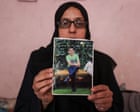
When Mohammad Abdul Zinati, 15, rushed to help a man wounded in a bomb attack, he had no time to react before he too was hit. Plus, meet the cartographers who took on centuries of western bias Good morning. Mohammad Abdul Zinati was walking home from school through the rubble of Salah Khalaf Street in northern Gaza City when he stopped at a supermarket where a group of classmates and friends had gathered. What has Israel said about the incident? The Israeli military said the incident was under review. The IDF has repeatedly rejected allegations that it deliberately targets civilians, saying it assesses and takes into account the risk of civilian harm when carrying out strikes. What has Trump said about South Korea? Trump has criticised Seoul for what he called insufficient support for the Iran war and scaled back major joint military drills by the two countries’ armed forces this summer, a move that unsettled the US ally. Continue reading...
 Sep 18, 2026 · byThe Guardian
A war-damaged building collapses in Gaza City, killing at least 21 Palestinians and exposing fears of unsafe ruins.
Sep 16, 2026 · byAl JazeeraCountry: occupied Palestinian territory Source: Norwegian Refugee Council A war-damaged residential building collapsed in Gaza City on Wednesday, reportedly killing at least 20 people and exposing the deadly shelter choices facing thousands of displaced families as another winter approaches, warns the Norwegian Refugee Council (NRC). The seven-storey building housed displaced families despite earlier structural damage. Hundreds of damaged buildings assessed as unsafe remain occupied because families lack safer alternatives. Israeli authorities approved 36,960 pieces of timber and 660 emergency shelter kits in August, but rejected their entry on 26 August and 2 September. They subsequently denied a renewed coordination request by the UN, reportedly on security grounds. Israeli authorities have themselves acknowledged the scale of need. More than 80 per cent of respondents to its September online survey needed new tents. The authorities announced approval for the tents’ entry and said additional winter equipment would also be permitted. “Families in Gaza face an impossible choice between a damaged building that could collapse and a tent that could flood,” said Jan Egeland, NRC’s Secretary General. “Israeli authorities recognise the desperate need for shelter, yet repeatedly turn away even the materials they previously approved for delivery. Announced approvals of building materials and shelter kits cannot keep families safe. We need deliveries, not promises. And we need them before winter arrives.” The Palestine Shelter Cluster, led by NRC, found that only one in ten households received shelter or basic household assistance in the month preceding its June assessment. Nearly two-thirds lived in tents or makeshift shelters, more than half of which were in poor or very poor condition. Repairing damaged homes also remains beyond reach for many families. Among surveyed households living in damaged buildings, 71 per cent could not afford repair materials, while 49 per cent reported that materials were unavailable locally. The collapse also exposed the shortage of equipment needed to rescue people trapped beneath the rubble. Egypt provided heavy machinery, but the UN Humanitarian Coordinator called for urgent entry of additional machinery, specialised equipment, engine oil and fuel to sustain rescue efforts. In the June assessment, 71 per cent of surveyed households reported flooding. With winter approaching, NRC calls on Israeli authorities to enable immediate, predictable and sustained entry of tents, tarpaulins, repair and construction materials, fuel and heavy machinery at volumes matching assessed needs. Essential shelter supplies must reach families without delay and before winter arrives. Donor governments must urgently fund safe repairs, drainage, flood protection and adequate winter shelters. Mohammed Al-Aklouk, the Shelter Cluster’s Information Management Coordinator, lives with his family in a damaged rented house. “The house I rent has no windows, only plastic sheeting, but compared with a tent, it feels like a palace. My youngest son just wants somewhere safe to play football. My children keep telling me: ‘We’re prisoners inside the house. We want to breathe',” said Al-Aklouk. Notes to editors The Shelter Cluster’s August 2026 report, Exposed on All Sides: Shelter Severity and Household Needs Across Accessible Areas of Gaza , draws on 1,951 household interviews conducted between 14 and 28 June 2026 in accessible areas of North Gaza, Gaza, Deir al-Balah and Khan Younis. Rafah and other inaccessible areas were excluded. The assessment achieved an approximate aggregate margin of error of ±2.4 percentage points at the 95 per cent confidence level. The Shelter Cluster report found that 94 per cent of the estimated population in the areas covered required shelter or basic household assistance. It classified 84 per cent of assessed households as facing Critical or Catastrophic domestic living conditions, reflecting severe constraints on essential activities, including sleeping, cooking, washing, storing food and water, and maintaining adequate lighting and thermal comfort. The UN’s humanitarian situation report of 11 September documents the August approval and subsequent rejection of the timber and emergency shelter kits on 26 August and 2 September, followed by the renewed denial. The shipment contained framing materials and basic construction tools needed for emergency repairs and shelter improvements. The UN Humanitarian Coordinator’s statement of 16 September warns that hundreds of damaged buildings assessed as unsafe remain occupied. It calls for urgent entry of rescue equipment, machinery, engine oil and fuel, alongside essential shelter assistance within four weeks. COGAT’s September online survey found that more than 80 per cent of respondents identified a need for new tents. COGAT subsequently announced approval for their entry and said additional winter equipment would also be permitted, as reported by Israel National News on 7 September 2026. The Palestine Shelter Cluster coordinates humanitarian organisations working on shelter needs in Gaza and the West Bank. NRC leads the Cluster, with the International Organization for Migration serving as co-coordinator. For more information or to arrange an interview, please contact: NRC global media hotline: media@nrc.no, +47 905 62 329
Sep 16, 2026 · byReliefWeb
Two people were killed in the assault on Gaza City - a paramedic and a 15-year-old boy returning from school.
Sep 16, 2026 · byAl JazeeraCountry: occupied Palestinian territory Source: Save the Children The building had been bombed previously during the war and displaced families were living there due to a lack of available shelter. At least eight children were reported killed early today, and dozens more are among 100 people missing following the collapse of a six or seven story building damaged by an earlier Israeli strike in Gaza City. As rescuers comb through the rubble, some digging with their bare hands, Israeli restrictions on the entry of essential machinery and rescue equipment are directly hampering efforts to reach people trapped beneath the rubble, putting more lives at risk. Save the Children said Israel must lift these restrictions immediately and live up to its obligations under the so-called ‘ceasefire’ agreement. The Palestinian Civil Defence in Gaza said at least 50 children could be among the missing. More than 10 families lived in the building, which also reportedly fell on tents and makeshift shelters nearby. The building had been bombed previously during the war and displaced families were living there due to a lack of available shelter. The Civil Defence warned that some 2,000 damaged buildings , currently sheltering large numbers of people, are at risk of collapse. Shuroaq, Save the Children Media Manager in the occupied Palestinian territory: “ At dawn while we were sleeping, we heard a blast that sounded like bombing, and the whole house was covered in dust. We thought the building we were in was the target. I have just came back from the site and everyone in Gaza is there trying to help with rescue teams. The situation is dire. People are screaming, and others are digging with their bare hands. Children could be heard screaming and pleading for help from underneath the rubble. “The building is huge. There are people missing from the tents near the building that collapsed on them. People are scared that with the scarcity of equipment and machinery the rescue machine will take days. In Gaza buildings are constantly collapsing on displaced families. These things have been constantly happening, but this is a huge building. Dozens were living there. “I saw the bodies of a woman and her child being recovered. They were lying together on a mattress where they had been sleeping. This is not a sight that anyone should or ever could ever get used to. I know a family who lived in this collapsed building. They had only recently moved there, fleeing the artillery shells that were close to their tent. Most of the family members are children, and no one from the family has been recovered yet. This is a danger that threatens everyone here in Gaza.” Hiba AlHejazi, Save the Children Advocacy, Campaigns, Communications and Media Director in the occupied Palestinian territory: “Nearly a year after its signing, the so-called ‘ceasefire’ continues to fail children. This tragedy did not happen in isolation. Israel’s destruction of homes has displaced families, while its restrictions on the entry of tents, shelter materials and reconstruction supplies have left them with no safe alternative but to live in damaged and unstable buildings. When those buildings collapse, the same restrictions leave rescue teams digging through the rubble with their bare hands. “Israel is actively blocking the equipment and machinery needed to rescue people and support meaningful recovery and reconstruction. These restrictions must be lifted immediately. The international community must act urgently to press Israel to lift them, or we will continue to witness entirely preventable mass-casualty events like the one we saw this morning.” \
Sep 16, 2026 · byReliefWeb
Israel-hit building collapsed in Gaza City, killing 20 and leaving dozens trapped under the rubble.
Sep 16, 2026 · byAl Jazeera
Rescuers are searching through the rubble for survivors after a damaged apartment building collapsed overnight in Gaza.
Sep 16, 2026 · byAl Jazeera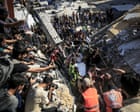
Rescue workers say search for dozens of people hampered by lack of heavy machinery A building housing displaced Palestinian families collapsed on Wednesday in Gaza City, killing at least 16 people, as rescuers searched the rubble for dozens of people including children believed to be trapped. A rescue team from Gaza’s civil defence said they had recovered the bodies of five children among the victims, while 14 injured people were taken to hospital. Medical sources said rescuers could hear the voices of people trapped beneath the rubble as they tried to reach them. Continue reading...
Sep 16, 2026 · byThe Guardian
A building housing half a dozen families gave out in Gaza City overnight into Wednesday, killing 19 people as they slept and leaving rescuers digging through rubble for dozens more who had been sheltering inside the structure.
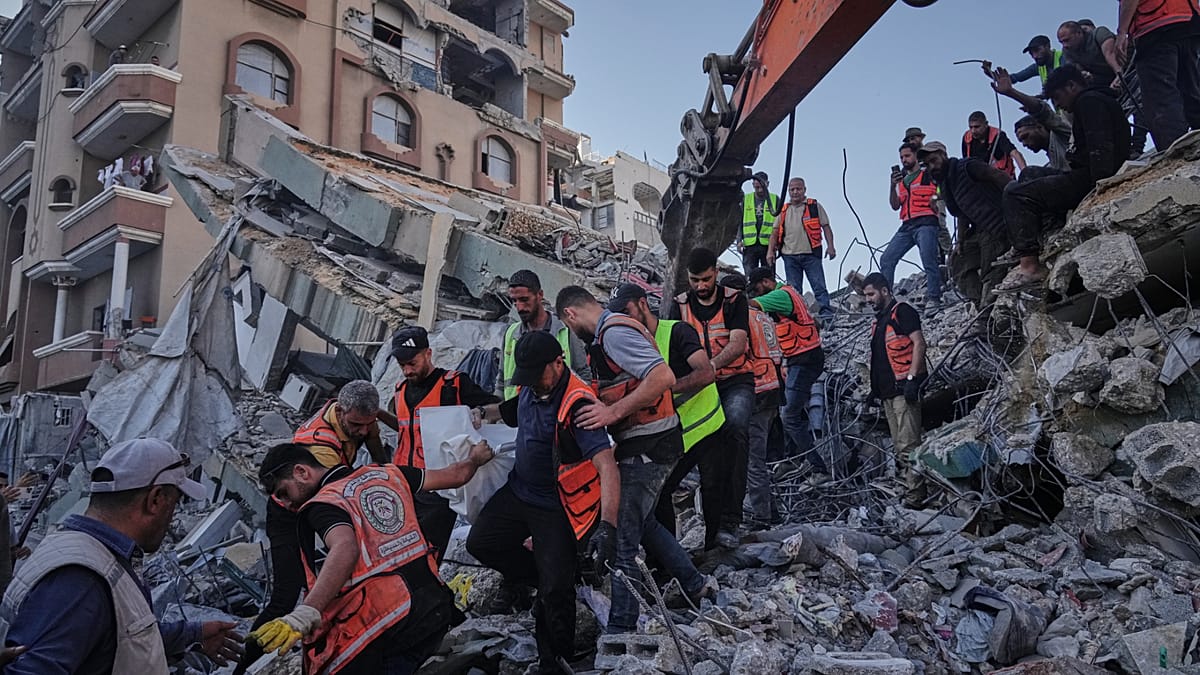
A deadly building collapse has killed at least 12 people in Gaza City on 16 September, according to Shifa Hospital, after a multi-storey building housing displaced families came down.
 Sep 16, 2026 · byEuronews
Dozens of people are missing beneath the rubble of the building in Gaza City, where 10 families had reportedly been living.
 Sep 16, 2026 · byBBC
At least 10 Palestinians are dead and up to 70 more are believed missing after a building collapsed in Gaza City.
Sep 16, 2026 · byAl Jazeera